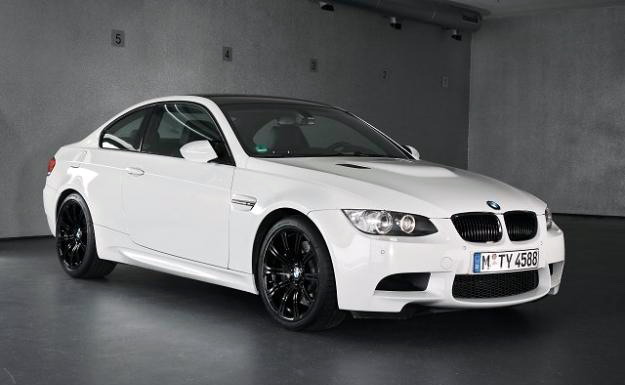
BMW M3 Coupe US-Version - BMW once again proves there is nothing inherently slow about evolution with the introduction of the 2008 BMW M3 Coupe, fourth in the line of compact sport coupes that set the standard in minimizing any compromises between race-inspired performance and luxury and convenience!
The all-new 2008 BMW M3 Coupe and BMW M3 Sedan features the first V8 in a series-production BMW M3, and cost $57,275 and $54,575 respectively. It also features driver-adjustable settings for crucial dynamic controls encompassing engine response, steering, damping and stability (with an available steering-wheel-mounted "MDrive" button to store the preferences), and a sporting interior that can be optimized to the driver's desires including the comprehensive entertainment/navigation system operated through BMW's latest iDrive controller!
Servotronic steering with two manually adjustable control maps
Rear-wheel drive keeps the rack-and-pinion steering of the BMW M3 Coupe free of drive forces. A further enhancement is hydraulic Servotronic power assirtance controlling steering forces as a function of road speed. There is also a choice of two different control maps activated through normal and sport modes with a console-mounted button.
In Sport mode the BMW M3 provides direct and immediate response with a relatively high steering effort. In the Normal mode, power assistance is comfort-oriented and requires less steering effort.
Interior design oriented an active driving experience with luxury
The interior of the BMW M3 has always been a place designed for performance driving, but without compromising the comfort of the driver and the passengers. The new BMW M3 Coupe continues this tradition with the latest innovations. The four seats are surrounded by powerful contours and flowing lines highlighting in particular the concave and convex surfaces. The horizontal lines dominating the area around the dashboard as well as the harmonious surfaces of the side linings give the interior a dynamic note.
The cockpit control area tapers out between the front seats into a newly designed center console which discreetly "swings" towards the driver. Finished in black leather, the console harmoniously continues the instrument surrounds and the control area in terms of both color and shape, comprising three function switches (Power, DSC, and optional EDC) for activating and deactivating the electronic driving programs on the side facing the driver.
Apart from the clear design and optimum ergonomic arrangement of all controls and instruments, the choice of colors inside the new BMW M3 Coupe helps the driver concentrate on driving. Regardless of the upholstery and trim color, the footwells, parcel shelf, headliner, A-pillar trim and the upper part of the instrument panel are all finished in Anthracite. This uniform, dark color scheme around the windshield helps the driver focus on driving.
There is no question as to the heritage of the vehicle upon opening the door of the new BMW M3 thanks to the M car logo in the door sills. The unique nature of the vehicle carries to the dash where the dual circular instruments typical of BMW - the speedometer and fuel gauge as well as the tachometer and oil temperature display - are in specific M style. A feature typical of BMW M cars is the variable warning zone on the tachometer that informs the driver of the recommended engine speed depending on the engine oil temperature. The borderline between the yellow pre-warning zone and the red warning zone moves up as a function of increasing oil temperature to the maximum limit of 8,300 rpm. The digital displays presenting the time, the outside temperature and odometer, as well as the various warning lights, are positioned between the two circular instruments.
The M3's leather steering wheel, with its thumb contours resting firmly in the driver's hands, provides an optimum grip for precise movement of the steering wheel. The spokes within the steering wheel incorporate the remote control buttons for the audio system and mobile phone, as well as the optional MDrive button. An additional auxiliary button may be programmed through the optional BMW iDrive system.
As an option, both the front seats are available with backrest-width adjustment, while the rear seats may be equipped with folding seatbacks which provides the 15.2 cubic foot luggage compartment even greater capacity.
A premium AM/FM/single-disc CD audio system comes standard with an auxiliary input jack. Individual entertainment options include SIRIUS satellite radio, HD radio and a USB-enabled port for control of an Apple iPod or iPhone media player. These three options can be bundled together in the Technology Package, should one choose to have them all together.
For vehicles equipped with Navigation, the comprehensive information and entertainment systems are controlled by the refined BMW iDrive. Selecting the Navigation/iDrive option also brings the performance-oriented, steering-wheel-spoke-mounted Mdrive button.
Safety begins with the body structure and continues inside
Occupant safety begins with the design of the new BMW M3's body structure. Together with defined deformation zones, the use of high-strength steel ensures smooth and direct transmission of forces in a collision and optimum absorption of loads acting on the car. The space available for deformation is also used to avoid any damage to the passenger cell and keep damage to the body itself to a minimum, even in a severe collision.
Showing posts with label BMW. Show all posts
Wednesday, December 7, 2011
Sunday, July 17, 2011
Saturday, April 16, 2011
Report: Saab in Talks with BMW on Underpinnings, Engines for Revived 92
It’s no secret that Saab is hard at work on plans to reintroduce its 92, but it’ll need some help to before the car can be produced. The automaker is preparing to enter into talks with BMW to do just that.
Instead of developing a costly platform from scratch, Saab is in talks with BMW to source underpinnings for the car. Saab is reportedly eyeing Mini’s architecture to underpin the new 92. Saab CEO Victor Muller wants the brand’s new model to closely resemble the teardrop shape of the original car, which was dropped from the Saab lineup in 1956.
According to the report, Saab is also looking into sourcing engines and transmissions from Mini. Mini currently offers 1.6-liter naturally aspirated and turbocharged inline four-cylinder engines here in the States, and 1.4-liter gasoline and 1.6-liter diesel I-4 powerplants are available also. Transmission choices are limited to six-speed manual and automatic gearboxes.
With Saab trying to regain market share, this would be a great move for the marque, but the 92 would be a direct competitor of the Mini Cooper. Although producing components in larger quantities would be beneficial to lower costs, we’re not sure it’s a great idea for Mini to bolster its own competition.
Would it be a good move for Mini to help Saab, or would it cannibalize its own sales?
Source: Reuters and automobilemag
Instead of developing a costly platform from scratch, Saab is in talks with BMW to source underpinnings for the car. Saab is reportedly eyeing Mini’s architecture to underpin the new 92. Saab CEO Victor Muller wants the brand’s new model to closely resemble the teardrop shape of the original car, which was dropped from the Saab lineup in 1956.
According to the report, Saab is also looking into sourcing engines and transmissions from Mini. Mini currently offers 1.6-liter naturally aspirated and turbocharged inline four-cylinder engines here in the States, and 1.4-liter gasoline and 1.6-liter diesel I-4 powerplants are available also. Transmission choices are limited to six-speed manual and automatic gearboxes.
With Saab trying to regain market share, this would be a great move for the marque, but the 92 would be a direct competitor of the Mini Cooper. Although producing components in larger quantities would be beneficial to lower costs, we’re not sure it’s a great idea for Mini to bolster its own competition.
Would it be a good move for Mini to help Saab, or would it cannibalize its own sales?
Source: Reuters and automobilemag
Sunday, March 13, 2011
BMW Recalls, Halts Sales of 1 Series Models; Cites Fire Risk
New information released on the National Highway Traffic Safety Administration's website shows that BMW is recalling all 1 Series models sold in the U.S. between 2008 and 2010 for a potential fire risk.
According to the manufacturer, cars built between December 1, 2007, and May 27, 2010, may not have sufficient clearance between the seatbelt tensioners and the sound insulation in the B-pillars. Should a crash occur, the tensioners could overheat. In rare instances, the excess temperature could possibly ignite the insulation material.
BMW has not yet released a fix for the issue, but has notified NHTSA of the recall and halted sales of all 1 Series models until it rectifies the design issue. BMW will notify owners of the recall shortly and provide updated information to NHTSA when it has a fix. For more information, contact your local BMW dealership.
Source: NHTSA automobilemag
According to the manufacturer, cars built between December 1, 2007, and May 27, 2010, may not have sufficient clearance between the seatbelt tensioners and the sound insulation in the B-pillars. Should a crash occur, the tensioners could overheat. In rare instances, the excess temperature could possibly ignite the insulation material.
BMW has not yet released a fix for the issue, but has notified NHTSA of the recall and halted sales of all 1 Series models until it rectifies the design issue. BMW will notify owners of the recall shortly and provide updated information to NHTSA when it has a fix. For more information, contact your local BMW dealership.
Source: NHTSA automobilemag
Thursday, March 10, 2011
Two tuners have worked their magic to turn out their own versions of the latest BMW M3 that are, respectively, faster and more carbon-fibery Ultimate Driving Machines.
On the speed side, wheel tuner Emotion Wheels has expanded its business to include full tuning packages. In the case of the E92 M3, Emotion has eked out 707 horsepower from the V-8 that usually produces 414, claiming "significant" improvement in straight-line performance. Emotion's full upgrade also includes 19-inch black matte wheels, exterior styling enhancements, and a carbon-fiber hood.
Speaking of carbon fiber, aftermarket supplier Arkym is now offering a hood, trunk, and spoiler made from the lightweight stuff
Arkym's kit will set you back $1999 for the single-side hood (add $500 to make it a double), and $1249 for the single-side trunk (add $450 for the double). No pricing information has been released for the Emotion power and appearance package.
source by automobi
On the speed side, wheel tuner Emotion Wheels has expanded its business to include full tuning packages. In the case of the E92 M3, Emotion has eked out 707 horsepower from the V-8 that usually produces 414, claiming "significant" improvement in straight-line performance. Emotion's full upgrade also includes 19-inch black matte wheels, exterior styling enhancements, and a carbon-fiber hood.
Speaking of carbon fiber, aftermarket supplier Arkym is now offering a hood, trunk, and spoiler made from the lightweight stuff
Arkym's kit will set you back $1999 for the single-side hood (add $500 to make it a double), and $1249 for the single-side trunk (add $450 for the double). No pricing information has been released for the Emotion power and appearance package.
source by automobi
Saturday, June 5, 2010
etro Repeat: BMW 328 Coupe Wins 2010 Mille Miglia
Seventy years after a BMW 328 first won the event, a 328 Touring Coupe managed to win this year's 1000-mile Mille Miglia race in Italy.
Despite the car's age (it rolled off the line back in 1940), drivers Giuliano Cané and Lucia Galliani suffered no technical issues, although arriving at the event was itself a feat. As was the case back in 1940, the BMW wasn't trucked to the starting line, but driven nearly 300 miles from the company's museum in Munich, Germany, to the checkpoint in Brescia, Italy. Such was the case for the 328 piloted by Enzo Ciravolo and Maria Lietner that ultimately finished third.
Although the cars proved reliable, the race was still quite a challenge. The 1000-mile route takes teams throughout Italy, providing them with both 80-degree heat near the Adriatic Sea and frigid temperatures in the Alps. In a brilliant marketing move, BMW provided drivers -- especially those who fielded the roofless 328 Roadster -- with insulated clothing from its motorcycle accessory range.
"Victory by Cané and Galliani, along with the third place finish of Ciravolo and Leitner, is a marvelous example of teamwork," said Karl Baumer, the director of BMW Classic. "Both the blind understanding between the crews inside the cars and the cooperation with the mechanics along the way worked out perfectly. For that, I would like to say 'thank you' to all those involved."


Source: BMW
Despite the car's age (it rolled off the line back in 1940), drivers Giuliano Cané and Lucia Galliani suffered no technical issues, although arriving at the event was itself a feat. As was the case back in 1940, the BMW wasn't trucked to the starting line, but driven nearly 300 miles from the company's museum in Munich, Germany, to the checkpoint in Brescia, Italy. Such was the case for the 328 piloted by Enzo Ciravolo and Maria Lietner that ultimately finished third.
Although the cars proved reliable, the race was still quite a challenge. The 1000-mile route takes teams throughout Italy, providing them with both 80-degree heat near the Adriatic Sea and frigid temperatures in the Alps. In a brilliant marketing move, BMW provided drivers -- especially those who fielded the roofless 328 Roadster -- with insulated clothing from its motorcycle accessory range.
"Victory by Cané and Galliani, along with the third place finish of Ciravolo and Leitner, is a marvelous example of teamwork," said Karl Baumer, the director of BMW Classic. "Both the blind understanding between the crews inside the cars and the cooperation with the mechanics along the way worked out perfectly. For that, I would like to say 'thank you' to all those involved."


Source: BMW
Fast Art: Jeff Koons’ BMW M3 GT2 Art Car Revealed
We’ve seen previews of BMW’s latest Art Car, but we hadn’t seen the finished product -- a M3 GT2 racer decorated by artist Jeff Koons -- until its official unveiling in Paris this morning.
With its 17th Art Car, BMW is returning to its roots, and actually racing the Koons-styled GT2 in the 2010 24 Hours of Le Mans. The first Art Car -- a 1975 3.0 CSL -- was the brainchild of driver Hervè Poulain, who commissioned artist Alexander Calder to dress up the exterior. Poulain ultimately raced the car at Le Mans that year, while two other Art Cars -- a 1976 3.0 CSL decorated by Frank Stella, and a 1979 M1 Procar painted by Andy Warhol -- also competed in the endurance race.
Unlike those early Art Cars, Koons’ product isn’t actually painted. Thanks to both a tight timeframe and the weight-conscious mindset of BMW’s racing directors, Koons applied his radical pattern to the M3 GT2 with a vinyl wrap. Better yet, the vinyl wrap process allows Koons’ design to be applied to a number of spare parts -- important, should the M3 suffer a collision during the Le Mans event.
Before crafting his design, Koons was given the chance to witness the M3 GT2 in action for inspiration. According to the artist, he was reportedly inspired by the “raw, unfiltered performance” of the GT2, and decided to give the M3 a design that gives the impression of motion even when at a standstill.
“These race cars are like life; they are powerful and there is a lot of energy,” Koons said. “You can participate with it, add to it, and let yourself transcend with its energy. There is a lot of power under that hood and I want to let my ideas transcend with the car -- it’s really to connect with that power.”
Koons’ M3 GT2 was unveiled earlier today at Paris’ Centre Pompidou, the same venue Roy Lichtenstein used to unveil his 320i Art Car back in 1977. The car will be on public display today, before the car heads to Circuit de la Sarthe for the 24 Hours on June 12 and 13.


Source: BMW
With its 17th Art Car, BMW is returning to its roots, and actually racing the Koons-styled GT2 in the 2010 24 Hours of Le Mans. The first Art Car -- a 1975 3.0 CSL -- was the brainchild of driver Hervè Poulain, who commissioned artist Alexander Calder to dress up the exterior. Poulain ultimately raced the car at Le Mans that year, while two other Art Cars -- a 1976 3.0 CSL decorated by Frank Stella, and a 1979 M1 Procar painted by Andy Warhol -- also competed in the endurance race.
Unlike those early Art Cars, Koons’ product isn’t actually painted. Thanks to both a tight timeframe and the weight-conscious mindset of BMW’s racing directors, Koons applied his radical pattern to the M3 GT2 with a vinyl wrap. Better yet, the vinyl wrap process allows Koons’ design to be applied to a number of spare parts -- important, should the M3 suffer a collision during the Le Mans event.
Before crafting his design, Koons was given the chance to witness the M3 GT2 in action for inspiration. According to the artist, he was reportedly inspired by the “raw, unfiltered performance” of the GT2, and decided to give the M3 a design that gives the impression of motion even when at a standstill.
“These race cars are like life; they are powerful and there is a lot of energy,” Koons said. “You can participate with it, add to it, and let yourself transcend with its energy. There is a lot of power under that hood and I want to let my ideas transcend with the car -- it’s really to connect with that power.”
Koons’ M3 GT2 was unveiled earlier today at Paris’ Centre Pompidou, the same venue Roy Lichtenstein used to unveil his 320i Art Car back in 1977. The car will be on public display today, before the car heads to Circuit de la Sarthe for the 24 Hours on June 12 and 13.


Source: BMW
Subscribe to:
Posts (Atom)